
Engineers specifying slewing bearings for mobile cranes, aerial work platforms, solar trackers, industrial turntables, and construction equipment encounter the single-row four-point contact ball bearing more often than any other configuration. It handles axial, radial, and tilting moment loads simultaneously in a compact cross-section, integrates cleanly with external or internal drive gearing, installs with standard tooling, and delivers the load capacity the majority of slewing applications require at a cost no competing configuration can match across the same range.
Yet despite its ubiquity, the engineering that makes this configuration work is frequently misunderstood at the specification level. OEM engineers who treat it as a catalog item — selected by verifying that load ratings clear the numbers — miss the design variables that determine whether a single-row ball bearing reaches its rated life or falls short of it. Gothic-arch raceway geometry, nominal contact angle, preload magnitude, and the conditions under which four-point contact degrades to two-point contact all profoundly affect bearing performance in ways that standard catalog ratings alone cannot capture.
Understanding these principles enables engineers to specify this bearing correctly when it is the right answer — and recognize with equal clarity when it is not.
The Combined Loading Problem This Configuration Solves
Most rotating machinery bearing applications involve a dominant load type. Shaft bearings carry primarily radial load. Thrust bearings carry primarily axial load. Standard bearing designs reflect these dominant cases — deep groove ball bearings excel at radial loads, angular contact bearings handle combined axial and radial efficiently, thrust bearings address axial loads almost exclusively.
Slewing applications are different. The rotating joint between a fixed base and a rotating upper structure simultaneously carries all three load types in combinations that change continuously during operation. Axial load comes from the weight of the rotating upper structure. Radial load comes from wind forces, horizontal boom reactions, and dynamic swing forces. Tilting moment load — typically the dominant component — comes from the offset of heavy masses from the slewing centerline, trying to tip the upper structure sideways.
No standard bearing designed for a single dominant load type handles this combination efficiently in a compact package. Stacked angular contact arrangements, separate thrust and radial bearing combinations, and supplementary thrust elements all address pieces of the problem but require complex, heavy, expensive assemblies with multiple potential failure modes and demanding alignment requirements.
The single-row four-point contact ball bearing solves this problem cleanly — and the solution comes entirely from the gothic-arch raceway geometry that defines the configuration.
Gothic-Arch Raceway Geometry: How Four-Point Contact Works
The four-point contact bearing's ability to simultaneously handle axial, radial, and moment loads in a single compact row derives from the geometry of its raceways.
The Gothic-Arch Profile
In a standard deep-groove ball bearing, each raceway has a single circular arc cross-section. The ball contacts each raceway at one point, producing two total contact points per ball — one on the inner ring, one on the outer.
A gothic-arch raceway replaces the single arc with two circular arcs joined at a cusp at the groove bottom — the cross-sectional profile used in gothic arch architecture. When a ball sits in this profile, it contacts each of the two arcs separately, creating two contact points per raceway face. With gothic-arch profiles on both inner and outer raceways, a single ball has four simultaneous contact points — two on the inner ring and two on the outer — at symmetric angles above and below the bearing midplane.
This is the mechanism behind the bearing's combined load capability. Forces arriving from any direction resolve into components along the contact angles, with each contact point resisting load along its specific angular direction. The ball and all four contact points together form a statically determinate load path for any combination of axial, radial, and moment forces.
Contact Angle and Load Capacity
The nominal contact angle α — typically 35°–45° in slewing bearings — directly affects how load capacity is distributed between axial and radial directions.
Axial load capacity scales with sin(α). At 45°, 70.7% of each contact normal force contributes to axial resistance. At 35°, only 57.4% contributes. Radial load capacity scales with cos(α), moving inversely — at 45° radial and axial capacities are equal, while at 35° radial capacity is higher but axial is lower. Moment load capacity depends primarily on bearing pitch diameter, which provides the moment arm over which ball contact forces develop the tilting couple. This is why large-diameter single-row bearings resist very large tilting moments even with modest individual ball contact forces.
Contact angle selection involves a tradeoff. There is no geometry that simultaneously maximizes both axial and radial capacity — the angle must be chosen based on which load direction dominates the application. For most crane and construction equipment where moment and axial loads dominate, 45° is the standard choice. For applications with higher radial load fractions, 35°–40° may be more appropriate.
Load Stability and the Cusp
One characteristic of gothic-arch geometry that OEM engineers must understand: the four-point contact configuration is stable under combined loading but becomes geometrically indeterminate under pure radial loading with minimal axial or moment component. Under pure radial load, the ball has no stable equilibrium position in the groove and can oscillate between contact positions, causing noise, vibration, and accelerated wear.
This is a fundamental reason single-row four-point contact bearings are not appropriate for pure radial load applications. The bearing's designed operating condition is combined loading — axial, radial, and moment forces together — which establishes definite ball positions and stable contact.
SlewPro's slewing ring designs specify raceway geometry matched to the intended service conditions of each series, embedding application-appropriate contact geometry into the product design.
Preload: What It Controls and What It Costs
Preload — the deliberate introduction of compressive load between balls and raceways in the unloaded state — is one of the most important and least understood design variables in four-point contact slewing bearings.
What Preload Accomplishes
A bearing assembled without preload allows the inner and outer rings to shift relative to each other before full contact is established. For precise positioning applications, this play is unacceptable. Under moment loading, balls on the lightly loaded side of the ring can lose contact entirely, becoming free elements that skid and impact back into contact — generating damage, noise, and accelerated cage wear. Preload maintains minimum contact force on all balls throughout the load cycle, preventing skidding and stabilizing the bearing.
Preload also stiffens the bearing's response to applied loads, reducing positional deflection under given forces. For solar trackers, antenna platforms, and precision turntables, this stiffness is a critical performance characteristic.
Preload Magnitude and Tradeoffs
Light preload (1–3% of basic dynamic load rating C) eliminates clearance with minimal friction increase — appropriate when bearing life is the primary concern. Moderate preload (3–8% of C) prevents ball skidding and provides meaningful stiffness — appropriate for most crane, construction, and turntable applications. Heavy preload (8–15% of C) maximizes positional accuracy at the cost of higher friction and reduced fatigue life — appropriate for precision positioning.
The costs of preload are real. Higher preload increases static breakaway torque — critical for solar tracking applications where a limited-torque motor must overcome bearing resistance in cold conditions. And preload reduces fatigue life because preload contact forces add to applied load forces at every contact point. Light preload typically reduces L10 life by 5–15%, moderate by 15–30%, and heavy by 30–50% relative to zero-clearance operation under the same applied loads. These tradeoffs must be weighed explicitly during specification.
The Four-Point to Two-Point Transition
As axial load increases in one direction under sustained moment or thrust, the contact geometry shifts — the two contacts on the loaded side draw together while the two on the unloaded side separate, until the bearing transitions from four-point to two-point contact per ball. This two-point configuration is actually more efficient for sustained unidirectional loading, but the transition itself causes the contact ellipse to migrate across the raceway. If the bearing cycles between four-point and two-point contact repeatedly, wear develops at two sets of locations — accelerating surface fatigue.
Preload controls this transition by establishing the axial load level at which it occurs. Higher preload extends the four-point contact operating range, reducing wear-pattern shifting for applications with highly variable loading.
Combined Load Capacity: Why Moment Dominates
Translating actual operating loads into an equivalent load comparable to catalog ratings is where OEM engineers most commonly make specification errors — and the moment component is consistently the culprit.
The Moment Conversion
Tilting moment (M) is converted to an equivalent axial force using the bearing pitch diameter D:
Fa_equivalent = 4M / D
The factor of 4 accounts for non-uniform ball load distribution under moment loading. The total equivalent axial load becomes Fa_total = Fa + (4M / D), which is then combined with radial force using standard combined load factors from the bearing manufacturer's data.
Why This Matters
In nearly every crane and boom equipment application, the moment-derived equivalent load dominates by an order of magnitude. Consider a truck crane: upper structure weight of 8,000 lbs (direct axial), wind of 1,200 lbs (radial), and a 6,000 lb load at 12-foot radius creating 864,000 in-lbs of tilting moment. For a 36-inch pitch diameter bearing, the moment-derived equivalent axial force is 96,000 lbs — twelve times the direct weight. Selecting based on the 8,000 lb axial load alone would produce a bearing rated for roughly 10% of actual requirement.
Understanding that moment typically governs slewing bearing selection — and that moment arm length multiplies requirements directly — is the single most impactful insight for accurate specification. SlewPro's application engineering team provides equivalent load calculation support including FEA for complex load cases.
Load Spectrum Correction
Real operating cycles impose varying loads. A crane rated for 30 tons might lift maximum capacity on 10% of cycles, 70% capacity on 50%, and 40% capacity on the remaining 40%. Using the Palmgren-Miner cumulative damage rule, the equivalent constant load for this spectrum is approximately 67% of maximum — which triples predicted bearing life compared to the conservative maximum-load assumption. This correction frequently converts a marginal specification into one that comfortably meets service life targets.
Gear Integration
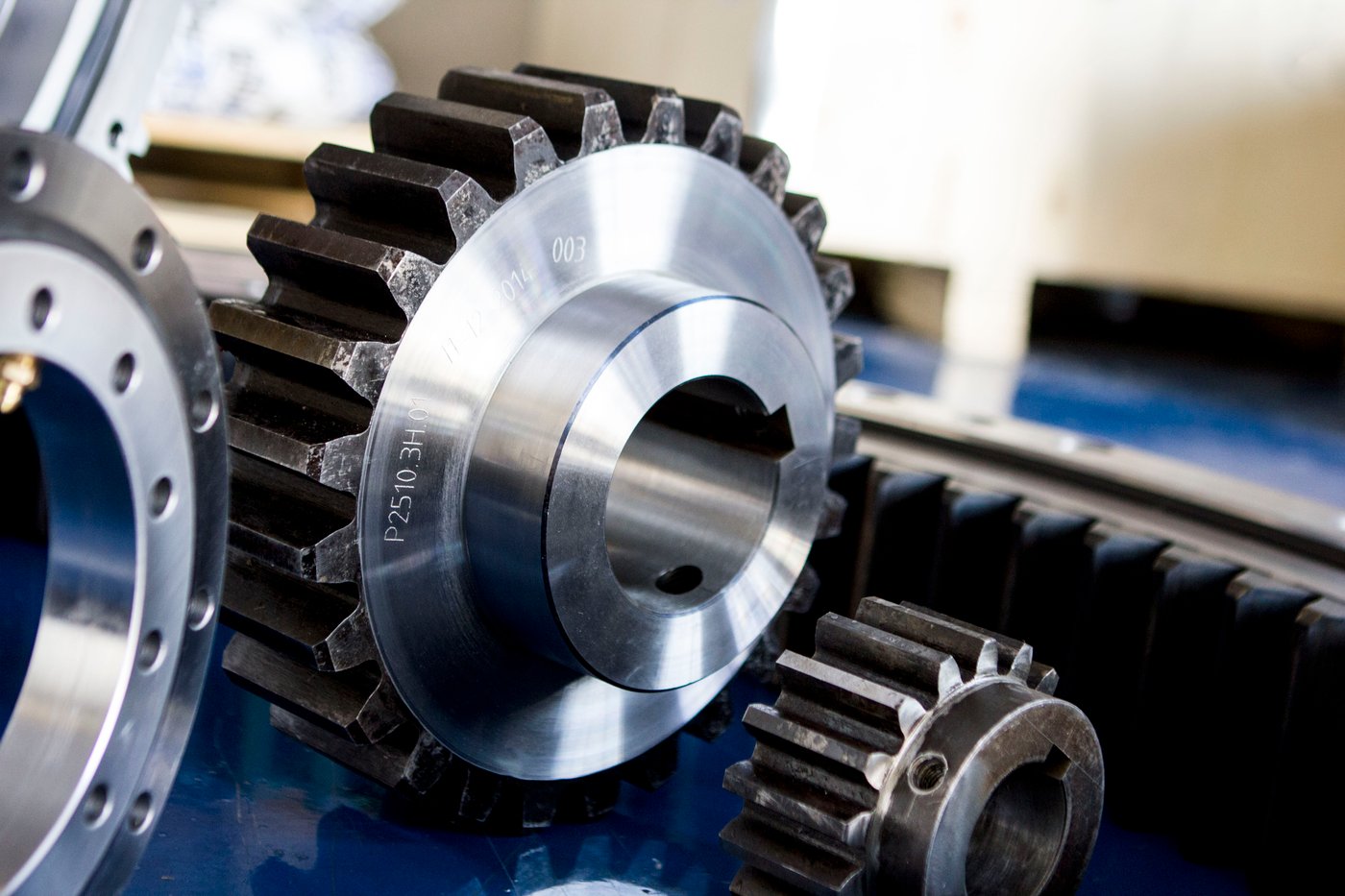
The majority of single-row four-point contact slewing rings include integral gear teeth on either the inner or outer ring. The choice between configurations and the gear quality specification interact directly with the bearing application.
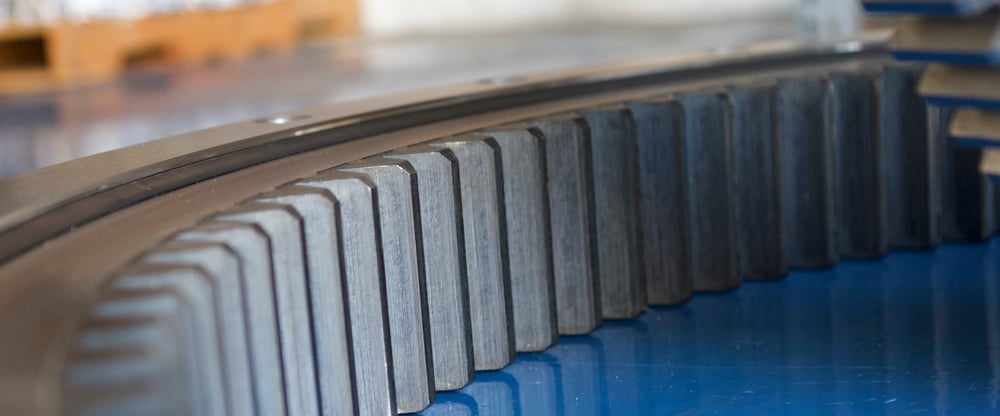
External gear teeth on the outer ring are most common for mobile cranes and construction equipment, allowing the drive motor and gearbox outside the ring diameter. External gears provide larger tooth size for a given ring diameter, improving strength and torque capacity. Internal gear teeth on the inner ring are used when packaging requires the drive inside the bearing, or when the enclosed geometry provides needed contamination protection.
Induction hardening of gear teeth to 55–60 HRC with 0.060–0.100" case depth addresses normal crane duty cycles effectively. Case carburizing to 58–62 HRC provides better fatigue and shock resistance for demanding applications at greater manufacturing complexity. AGMA Quality 8–9 (hobbed and hardened) is adequate for crane and construction equipment. AGMA Quality 10–12 (ground after hardening) substantially reduces noise — appropriate for aerial platforms, urban equipment, and noise-sensitive applications. SlewPro's Rhino Gear manufacturing covers both hardening approaches across AGMA quality levels 8 through 12.
The Economic Sweet Spot
The single-row four-point contact bearing delivers its best cost-efficiency in the moderate load range — tilting moment requirements from approximately 10,000 ft-lbs to 500,000 ft-lbs, bearing diameters from approximately 12 to 72 inches. This range covers the large majority of mobile crane, aerial work platform, industrial turntable, solar tracker, and utility equipment applications.
Compact Cross-Section
The single-row configuration compresses all three load capabilities into a cross-section that may be 40–60% of the height of double-row or roller alternatives with equivalent capacity. This height efficiency directly affects vehicle clearance height, chassis mounting geometry, and center of gravity — genuine design advantages for mobile equipment with strict transport envelope limits.
Manufacturing and Installation Simplicity
A single bearing row means one set of raceways, one cage, one set of balls, one set of seals, one lubrication circuit, and one alignment check during installation. The bearing is delivered pre-assembled and requires only cleaning, lubrication, and bolted mounting. Double-row or split-ring configurations may require field assembly of multiple rings, shimming, and more complex lubrication setup. For OEMs deploying equipment where slewing ring replacement must be performed by local service organizations without specialized tooling, this simplicity is a real commercial advantage.
SlewPro's slewing ring series — spanning the 21 Series through the 100 Series — cover the moderate load range with single-row four-point contact designs optimized for each size class.
Application-Specific Design Examples
Case Study: Mobile Truck Crane
Loading Characteristics: Dominant tilting moment from extended boom and lifted load. Moderate shock from load pickup and swing starts.
Design Optimization: 45° contact angle. Moderate preload (3–5% of C). External gear, module 10–14 mm. 42CrMo alloy steel, induction hardened raceways to 55–60 HRC with 0.080–0.100" case depth. Grade 10.9 or 12.9 mounting fasteners with mechanical thread-locking.
Result: SlewPro's standard slewing ring series include options directly suited to this loading pattern.
Case Study: Aerial Work Platform / Bucket Truck
Loading Characteristics: Moderate tilting moment. High cycle count from frequent repositioning. Noise sensitivity in urban environments.
Design Optimization: 40°–45° contact angle. Light-to-moderate preload. AGMA Quality 10–11 gear teeth. Precision-ground raceways (16 Ra or better) for smooth, quiet rotation. Multi-stage sealing.
Result: SlewPro's FGE Series enclosed slewing drives integrate this bearing class with sealed housing suited to aerial platform environments.
Case Study: Solar Tracking Array
Loading Characteristics: Predominantly moment load. Low axial and radial loads. Precision positioning. Wide temperature range. 20–25 year outdoor service life.
Design Optimization: 45° contact angle. Light preload minimizing breakaway torque for electric drive compatibility. Encoder integration. Synthetic EP grease. Corrosion-protected sealed housing.
Result: SlewPro's FWA Series slewing drives with encoder options, at quantities supported by SlewPro's inventory and fulfillment services.
Case Study: Industrial Turntable / Welding Positioner
Loading Characteristics: Nearly pure axial load from workpiece weight. Minimal moment. Precision positioning for process accuracy.
Design Optimization: 35°–40° contact angle. Heavy preload for maximum rotational stiffness. AGMA Quality 10–12 ground gearing. Exceptional runout and flatness tolerances.
Result: SlewPro's thin section bearings for lighter precision applications, and the 50 Series slewing rings for larger-diameter precision turntables.
Where Single-Row Four-Point Contact Stops Being the Right Answer
Competent specification requires equal clarity about where this configuration reaches its limits.
Extreme Tilting Moment Beyond Available Diameter
When the moment-derived equivalent axial force (4M/D) exceeds approximately 60–70% of the bearing's basic static load rating at the available diameter, the single-row configuration is at or beyond its practical limit. Double-row configurations develop moment capacity through the separation between two ball rows rather than ring diameter alone, enabling substantial moment capacity in a smaller ring. For large offshore cranes, mining shovels, and large wind turbine yaw bearings, double-row or three-row roller bearings are the technically appropriate choice.
High Radial Load Fraction
When radial load exceeds approximately 30–40% of total equivalent load, the four-point contact geometry loses efficiency. Crossed-roller bearings provide superior radial capacity through line contact of cylindrical rollers — larger contact area and lower contact stress for equivalent radial force. Applications with significant lateral loading warrant evaluating crossed-roller alternatives when the radial fraction approaches this threshold.
Continuous High-Speed Rotation
Four-point contact geometry generates problematic friction from differential slip at speeds above approximately 50 RPM continuous. Applications requiring sustained higher speeds should evaluate angular contact or deep-groove configurations designed for higher-speed service.
Extreme Shock Beyond S₀ = 5.0
Under extreme shock — continuous demolition hammering, hard-digging mining, severe forestry impacts — ball point contact concentrates forces on small contact ellipses that can exceed material limits even at maximum safety factors. Roller bearing configurations provide larger contact area and lower contact pressure for equivalent shock force. The SlewPro 100 Series addresses the heavy end of the spectrum where single-row ball geometry reaches its limits.
Specification Strategy for OEM Engineers
Load Characterization
Document all applied load components including tilting moment under worst-case boom position, direct axial load, radial load from wind and swing dynamics, and shock severity. Calculate the moment-derived equivalent axial force and confirm — as it nearly always does in crane and boom equipment — that moment dominates the specification. Do not omit wind loads on extended booms or dynamic swing loads, which are frequently left out of initial calculations and produce undersized selections.
Contact Angle and Preload Selection
45° contact angle for applications where axial and moment loads dominate. 35°–40° where radial load fraction is higher than typical. Light preload for limited-torque drives and life-priority applications. Moderate preload for most crane and construction equipment. Heavy preload for precision positioning.
Boundary Condition Verification
Before finalizing the selection, verify that the application does not exceed configuration limits: moment-derived equivalent load within 60–70% of basic static load rating; radial fraction below 30–40% of total equivalent load; continuous speed below 50 RPM; shock safety factor below 5.0. If any boundary is exceeded, evaluate the appropriate alternative before proceeding.
SlewPro's application engineering team provides support throughout this process including 3D modeling, FEA, and equivalent load calculation verification. Quotes are returned within 48 hours, and CAD files for all slewing ring series are available for immediate envelope verification.
Conclusion
The single-row four-point contact ball slewing bearing earns its place as the industry workhorse through genuine engineering merit. The gothic-arch raceway geometry that creates four simultaneous contact points per ball is an elegant solution to the combined loading problem that defines slewing applications, and single-row construction makes it the economically optimal choice across the broad middle of the load spectrum.
Contact angle governs the split between axial and radial capacity. Preload controls stiffness, ball skidding resistance, and the range over which four-point contact remains stable — while also setting a friction floor the drive system must overcome. And the moment-dominated equivalent load that governs nearly every crane and mobile equipment application must be calculated correctly, including the 4M/D conversion that consistently produces equivalent loads an order of magnitude larger than direct axial weight alone.
OEM engineers who understand these variables specify this bearing correctly when it is the right answer — and recognize when the application has moved beyond its limits.
SlewPro's complete slewing ring lineup — from the compact 21 Series through the heavy-duty 100 Series, complemented by thin section bearings and fully integrated slewing drives in the FGE and FWA series — provides the hardware options to match the right configuration to each application. Application engineering support including load case analysis and FEA ensures specifications are grounded in application reality rather than catalog assumptions.
Ready to specify a single-row ball slewing ring — or evaluate whether a different configuration is needed? Contact SlewPro or request a quote to start the conversation. With 48-hour quote turnaround, downloadable CAD files, and a competitor crossover database for replacement specifications, SlewPro provides the technical support OEM engineers need to get slewing bearing specifications right the first time.