
Here is how the conversation usually goes.
An engineer specs a geared slew bearing for a new machine. They run their loads, pick a diameter, choose an internal or external gear, send us the requirements, and order the bearing.
Then they go shop for a pinion.
Maybe they pull one from a catalog. Maybe they spec one to a separate gear supplier. Maybe their machine shop cuts it. The bearing arrives. The pinion arrives. They go into the assembly together. And about 80% of the time, that works fine — until it doesn't.
This is one of the most common, and most preventable, sources of trouble we see in slewing drive applications. The fix is straightforward: stop treating the pinion as an accessory. A geared slew bearing without its matched pinion is not a drive system. It is half of one.
A Bearing Gear and a Pinion Are a Mating Pair
This sounds obvious. In practice, it gets overlooked all the time.
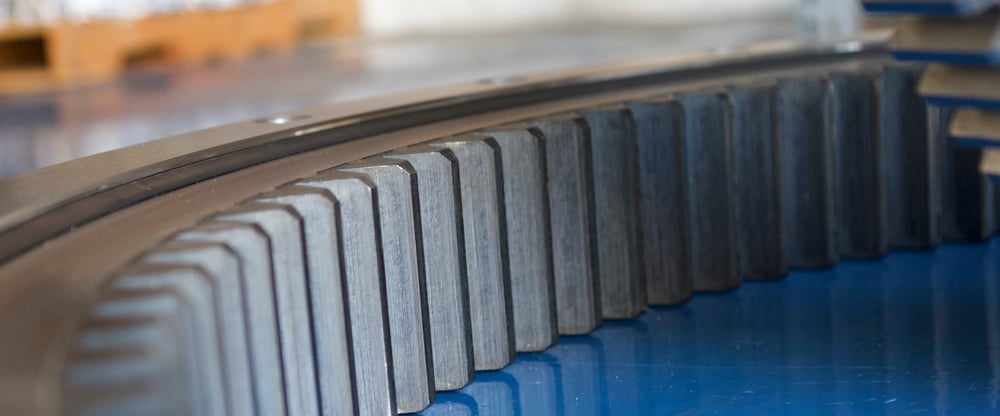
The gear teeth machined into a slew bearing are a precision feature. Module, pressure angle, face width, profile shift, root form, tooth surface finish — all of it has been specified, machined, and inspected to a defined standard. The mating pinion has to be designed against that standard if the mesh is going to perform the way you expect.
When the pinion comes from a different supplier, you are trusting two manufacturers to interpret the same specification exactly the same way. Most of the time they will. But "most of the time" is not a number you want in a load-bearing rotational drive that has to last for years.
We see the failure modes show up later, not at install. Premature wear on one set of teeth. Noisy operation. Inconsistent backlash around the rotation. Unexpected heat. None of these is catastrophic on day one. All of them shorten the life of the system.
Hardness Mismatch Is the Quiet Killer
The single most common pinion sourcing problem is hardness.
Slew bearing gear teeth are typically induction-hardened to a specific surface hardness range. The pinion needs to match — within a relatively narrow window — for the two parts to wear in together and reach their design life.
When the pinion is significantly harder than the bearing teeth, the bearing wears out first. When the pinion is significantly softer, the pinion wears out first. Either way, the system has been engineered to fail prematurely, and the engineer who specified it usually has no idea until the warranty calls start coming in.
A pinion ordered off a catalog comes with whatever hardness the catalog vendor offers. A pinion designed for a specific bearing comes with whatever hardness it needs.
Backlash and Precision Are System Properties, Not Component Properties
Backlash is not a feature of the pinion. It is not a feature of the bearing. It is a feature of how the two mesh.
When you specify and machine the pinion in coordination with the bearing, you can control backlash to a specification. You can hold it consistent around the full rotation. You can verify it on inspection.
When you source separately, backlash is whatever the tolerance stack-up gives you. It might be fine. It might be tighter on one side of the rotation than the other. It might drift as the gear teeth bed in. You will find out after the machine is built.
For precision applications — positioners, automation, anything with closed-loop control — this is not a small detail. It is the difference between a drive that performs and one that almost performs.
One Lead Time, One Supplier, One Accountability
Beyond the engineering case, there is a practical one.
When the bearing and the pinion come from the same supplier, you get one lead time, not two. You get one shipment, not two. You get one engineering review of the full mesh, not separate reviews of the two halves that may or may not align.
And when something does need to be addressed — a question on tolerances, a request for a design change, a warranty conversation — there is one phone number to call. No back-and-forth between bearing vendor and gear vendor. No finger-pointing about which side of the mesh is responsible.
This is not a small thing. Every project manager who has dealt with a mismatched mating pair already knows what we are talking about.
Telling Us About the Drive Side Matters
The bearing side of the mesh tells us the gear specification — module, pressure angle, face width, profile. That is half of the conversation. The other half is the driving side: what is actually turning the pinion, and how is it connected to it.
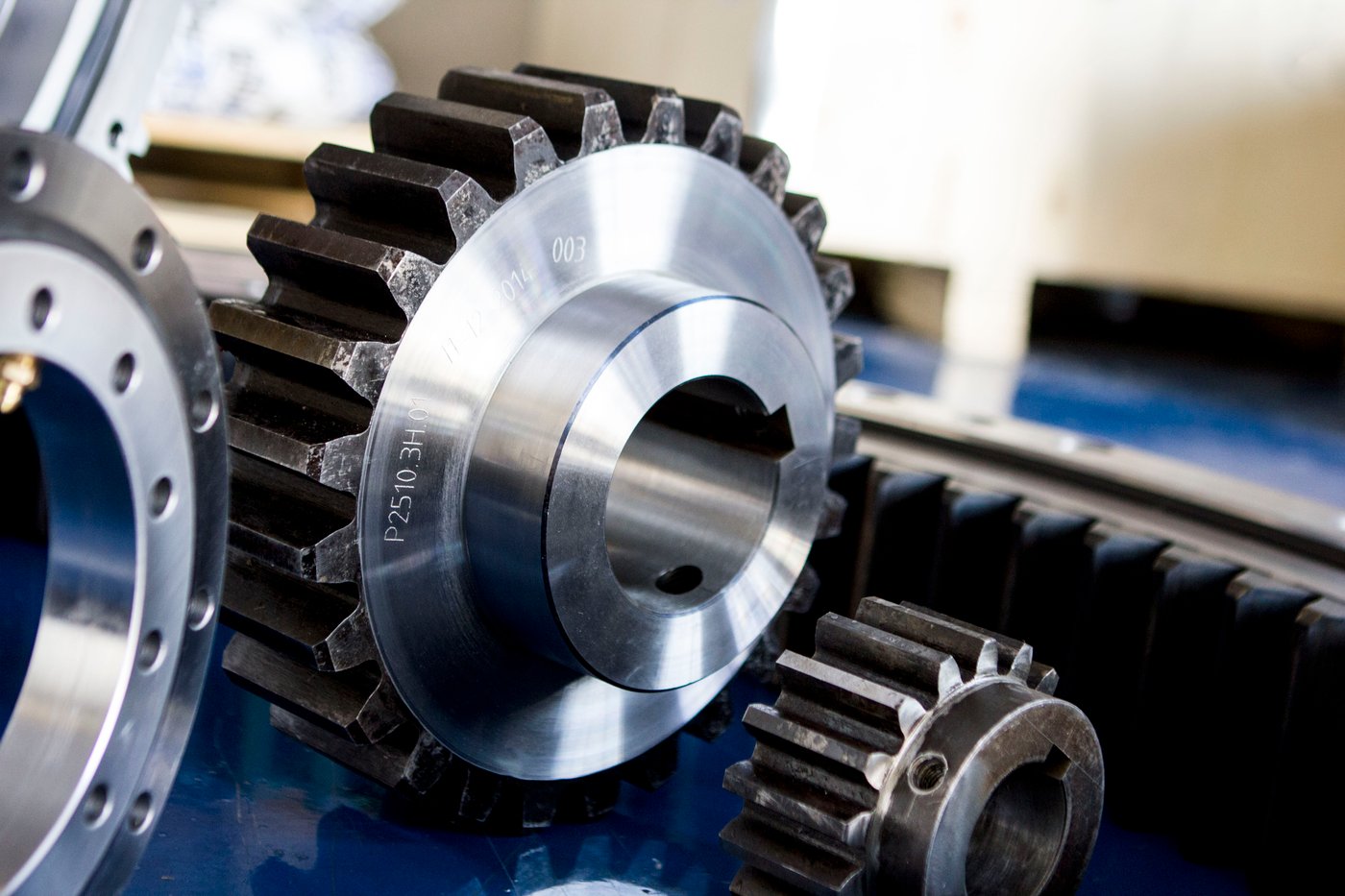
A pinion has to be designed not only to mesh with the bearing, but to attach to whatever is driving it. We build pinions in a range of mounting configurations to match the drive arrangement on your machine:
- Face mounted, for direct attachment to a motor or gearbox output flange
- Bored with keyway and set screws, for traditional keyed shaft connections
- Splined, for higher-torque drive shafts
- Plus numerous other mounting strategies depending on the application
When you send us the bearing requirements, send us the drive details with it: output shaft size, key or spline standard, mounting interface, and any space constraints around the drive. With that information, the pinion we engineer drops directly into your drive arrangement — no intermediate adapters, no compromises on fit, no surprises at assembly.
How We Do It at SlewPro and Rhino
Our slew bearings are built under the SlewPro brand. Our gears and pinions are built under the Rhino brand. Both brands belong to the same company, which means when a customer comes to us with a geared slew bearing application, we look at the full drive — bearing, gear teeth, mating pinion, and drive interface — as one engineering problem. When a customer comes to us with a geared slew bearing application, we look at the full drive — the bearing and the mating pinion — as one engineering problem.
That means the 3D model we send with every quote includes the pinion, not just the bearing. It means the hardness specification on the pinion is matched to the bearing it is going to mesh with. It means backlash is specified up front, not discovered on assembly. It means the mounting strategy on the pinion matches the actual drive arrangement on your machine. And it means one lead time, one shipment, and one engineering team accountable for the full drive.
None of this requires a different conversation with us. It just requires us to know what you are trying to drive. Tell us the application, and we will quote the pair.
The Bottom Line
If you are designing a machine that uses a geared slew bearing, your drive system has two halves. Buying one of them and sourcing the other elsewhere is a decision — usually an unconscious one — to accept the risks that come with it.
There is a better way to do it. The bearing and the pinion should be designed against each other, manufactured to compatible specifications, and delivered together. They should arrive as a system because they are going to operate as a system.
If you are quoting a slew bearing with us, ask us about the pinion. It is the easiest decision you will make on the project — and one of the highest-impact.