


One of the first decisions when choosing a slew drive is whether it needs one worm or two. Both turn a slewing ring through a worm gear, but they differ in torque, redundancy, size and cost. SlewPro builds both, with a range of motor options and modular configurations.
Single worm slew drives
One worm gear turns the slewing ring, giving smooth, controlled motion.
- Compact: suits applications where space is limited.
- Lower cost: fewer components.
- Efficient for light to moderate loads.
- Limits: lower torque capacity, so not suited to very heavy or off-center loads; one worm means less braking redundancy.
Best fit: solar trackers, small utility lifts, light-duty truck cranes, agricultural equipment.
Double worm slew drives
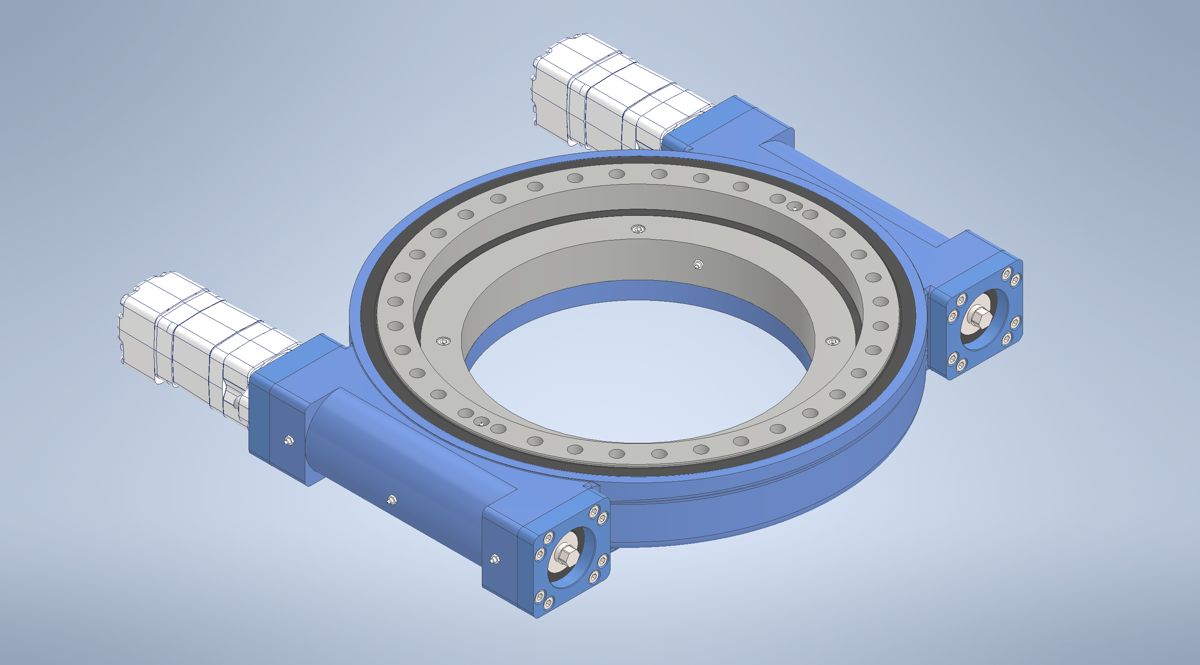
Two worm gears, usually 90° or 180° apart, drive the slewing ring together and share the load between them.
- More torque: handles heavy, off-center or high-momentum loads.
- Redundancy: two worms give more holding and braking capacity and greater stability.
- Safety: preferred where the drive holds a load or the application is safety-critical.
- Less wear per worm, because the load is shared.
- Limits: a larger footprint and higher cost.
Best fit: crane trucks and aerial platforms, construction and mining equipment, material-handling cranes, wind turbines, solar tracking power stations, high-load automation.
The FWA Series double worm drives
Our FWA Series double worm drives are fully sealed against wind, sand and water, with a thinner, higher-strength housing than a traditional slew drive. They are used for arm rotation on crane trucks, chassis rotation on aerial platforms and in solar tracking power stations, indoors and out.
Questions that decide it
- How much torque do you need, and how much holding torque?
- What are the safety requirements?
- Is space limited?
- What environment will the drive work in?
- Is the load dynamic, off-center or constant?
SlewPro options for either configuration
- tilting-moment capacity from 1,475 to 200,000 ft-lb
- hydraulic, electric or pneumatic motors
- open or enclosed housings
- encoders and brakes for precise positioning
Mounting matters too: see face, flange and shaft mounting options. If the standard range does not fit, our engineers will design a custom slew drive for your loads, space and environment. Contact us to talk it through.