
Moment at Production Cycle Rates
The dominant load is tilting moments from the loaded boom and bucket. A 30-ton class excavator generates 300,000–500,000 Nm at working radius; a 50-ton class machine can exceed 1,200,000 Nm. A single-row bearing can technically resist these moments at adequate diameter, but it does so with per-ball contact stresses in the upper fatigue range — acceptable for a crane performing dozens of lifts daily, inadequate for an excavator performing thousands.
Double-row geometry reduces per-ball contact stress by distributing the tilting couple across two rows separated axially, providing a second moment arm independent of ring diameter. Lower contact stress per ball translates directly to longer fatigue life at the cycle rates excavators impose.
Multi-Axis Combined Loading
Unlike crane swing, excavator swing simultaneously carries substantial loads in all three axes — and the proportions change continuously. Radial loading from digging crowd force can reach 100,000–200,000 N during aggressive digging. Double-row geometry distributes these radial forces across two rows, maintaining stable contact geometry under radial load fractions that would compromise single-row four-point contact stability.
Shock and Continuous Reversal
Bucket strikes on embedded rock, stick cylinder bottoming, and abrupt swing reversals at 8–12 RPM generate shock loads of 2–4× steady-state digging force. Double-row bearings distribute shock energy across twice the rolling element population. Continuous swing reversal under load also imposes dynamic inertial forces that double-row stiffness accommodates without the ring deflection that degrades gear mesh alignment in the swing drive.
Duty Cycle: Quantifying the Demand
Mass excavation and truck loading: 200–250 cycles/hour, two shifts, 300 days/year — approximately 35,000 cycles/day, 9–11 million cycles/year, 60–75 million cycles over 20,000 hours.
General construction: 120–180 cycles/hour, single shift, 250 days — approximately 8,000 cycles/day, 2–3 million/year, 36–54 million cycles over 20,000 hours.
Demolition: 80–150 cycles/hour with higher per-cycle shock severity — fewer total cycles but substantially higher fatigue damage per cycle.
Not every cycle imposes maximum load. A representative production earthmoving spectrum: 5–10% of cycles at 90–100% of maximum, 25–35% at 70–90%, 30–40% at 50–70%, and the remainder below 50%. Using Palmgren-Miner cumulative damage, the equivalent constant load is approximately 65% of maximum — extending predicted life by roughly 3.6× compared to a maximum-load-every-cycle assumption.
SlewPro's application engineering team works with excavator OEMs to develop application-specific load spectra from field data, strain gauge measurements, or hydraulic pressure recordings.
SlewPro's Double-Row Ball Configurations for Excavator Swing
SlewPro offers two double-row series suited to excavator swing, each optimized for different segments of the market.
The 40 Series is a double-row ball configuration with induction-hardened raceways and low starting torque. Raceway diameters from 12 to 180 inches. Moment capacity up to 24,000,000 ft-lbs, thrust to 8,700,000 lbs, radial to 860,000 lbs. The low starting torque reduces swing motor sizing, improving fuel efficiency on machines performing thousands of swing starts per shift. Available in plain, internally geared, and externally geared versions with matching pinions.
The 45 Series is an eight-point contact double-row ball configuration delivering maximum load capacity in a compact footprint. Raceway diameters from 18 to 170 inches. Moment to 18,000,000 ft-lbs, thrust to 6,500,000 lbs, radial to 1,200,000 lbs. The eight-point contact distributes load across more contact points per ball, improving fatigue life under multi-axis combined loading. The higher radial capacity (1,200,000 lbs vs. 860,000 lbs in the 40 Series) suits excavators where aggressive digging generates sustained radial crowd forces.
For the largest mining excavators and shovels where double-row ball capacity is exceeded, the 100 Series triple-roller slewing rings provide the highest capacity in SlewPro's range.
Critical Specification Details
Raceway Hardening
Both series use 42CrMo (AISI 4140/4142) with induction-hardened raceways at 55–60 HRC. Case depth of 0.080–0.120" must be sufficient to support subsurface shear stress under shock-amplified contact. For hard-digging service, specify the upper end (0.100–0.120") to prevent subsurface-initiated fatigue from shock events exceeding steady-state design loads.
Gear Teeth
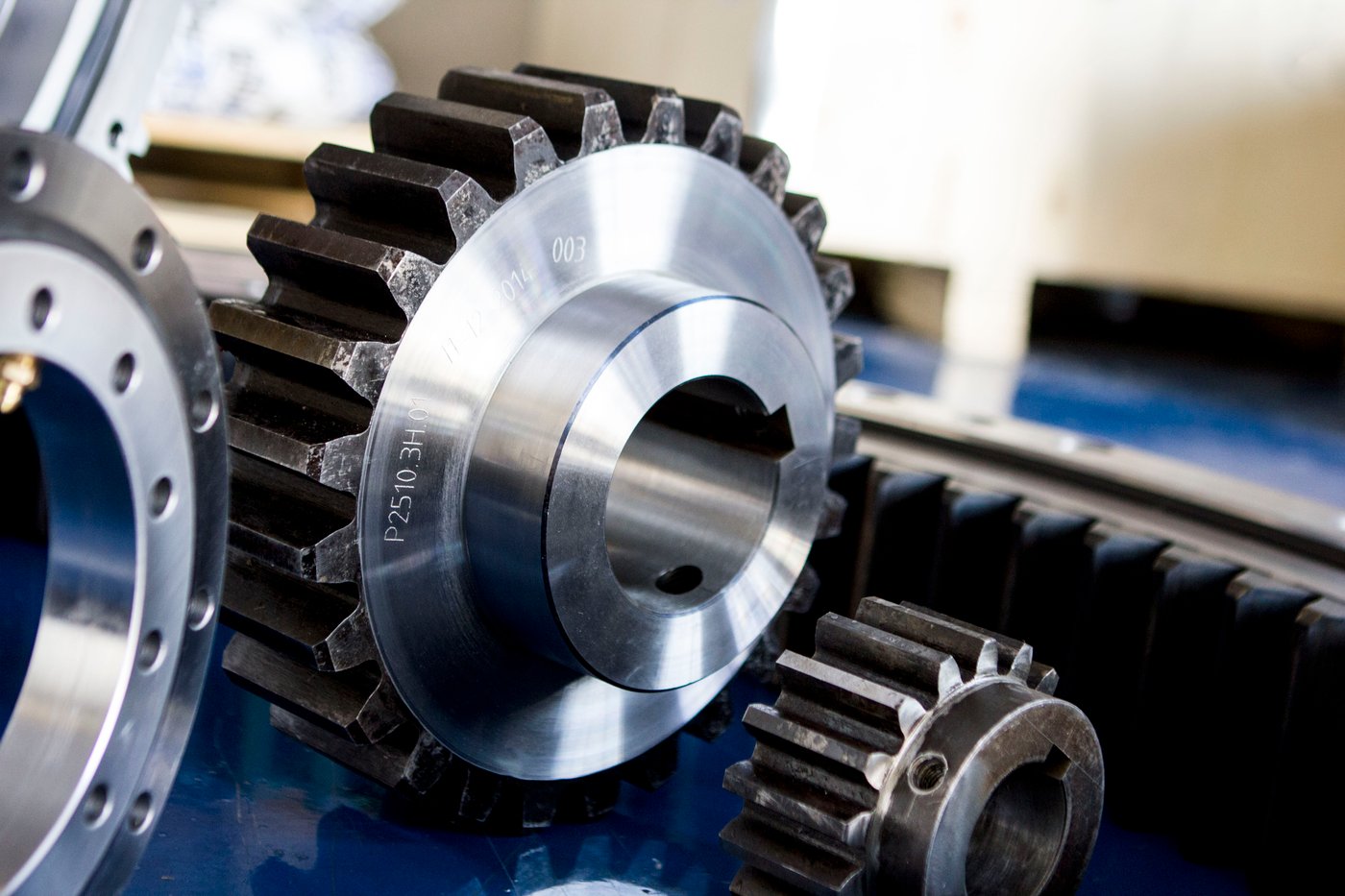
Induction-hardened gear teeth (55–60 HRC) are standard. For severe-duty demolition or continuous production, case-carburized teeth (58–62 HRC) provide superior fatigue resistance under elevated cycle counts and swing reversal loading. Rhino Gear manufacturing covers both hardening approaches with quality levels from AGMA 8 through 12 and matching pinion supply.
Sealing
Multi-stage sealing with exclusion scrapers, primary lip seals, and secondary backup seals is essential. Standard nitrile lip seals wear through in 3,000–5,000 hours in heavy earthmoving dust; polyurethane seals extend life to 8,000–12,000 hours. Proactive seal replacement at defined intervals prevents contamination-driven bearing damage far more expensive than the seal service itself.
Lubrication
EP-additive lithium complex grease with ISO VG 220–320 base oil. Relubrication intervals of 100–250 hours for production earthmoving — far shorter than the 500–1,000 hours typical of crane service. Automated lubrication systems ($2,000–$5,000 per machine) provide more consistent delivery than manual greasing and are recovered through extended bearing life within the first missed interval they prevent.
Mounting
Mounting surface flatness of 0.004–0.006" TIR — tighter than general practice because the high cycle rate amplifies fatigue damage from any load distribution non-uniformity. Grade 12.9 mounting bolts with mechanical thread-locking and bolt torque verification every 500–1,000 hours. Frame stiffness sufficient to limit bearing-plane deflection to less than 0.002–0.003" under maximum digging loads.
Conclusion
The excavator swing bearing is not governed by peak load — it is governed by the cycle rate at which that load accumulates fatigue damage. A bearing designed for crane or turntable service cannot survive excavator production service regardless of its load rating. Double-row ball geometry addresses this directly: lower per-ball contact stress, stable multi-axis load handling, shock distribution across twice the rolling element population, and stiffness to maintain alignment under continuous reversal.
SlewPro's 40 Series and 45 Series provide the capacity, configuration range, and material options excavator OEMs need. Application engineering support including duty cycle analysis, load spectrum development, and mounting specification review ensures the bearing is specified for how the machine actually works. Contact SlewPro or request a quote to start the conversation — with 24-hour turnaround, downloadable CAD files, and competitor crossover tables to support specification from concept through production.